Why do we have a sense of music?
We have a sense of music because hearing runs the same computation that runs the Universe, and music is sound built to exercise it. In OPH the world is a consensus protocol: observers compare records, repair what disagrees and settle into fixed points. A brain runs the same kind of fixed-point search. Its frequency channels must agree on which tones belong together, and a repeating sound lets them agree, because all its overtones share one period. Symmetry fixes what can settle. The 60 rotations of a cell sort its twelve readings into bands, one of them the three directions of space, and the repetition of a sound sorts it into overtones. An octave adds no new period, so it is the same note, higher. Twelve notes form the shortest cycle in which stacked fifths, the next simplest agreement, return to their starting note within a quarter semitone. Dissonance is disagreement heard as beating, and resolution is its repair, felt from the inside. A shared beat is a shared clock.
The math
A sound that repeats every contains only pure tones at whole multiples of , the harmonic series. The whole numbers label the patterns that a shift by leaves alone.
The same sorting on the cell: its 60 rotations split the twelve readings into four patterns, each fading at its own rate. The 1 is the total no observer can read; the slowest readable pattern is three wide and is space.
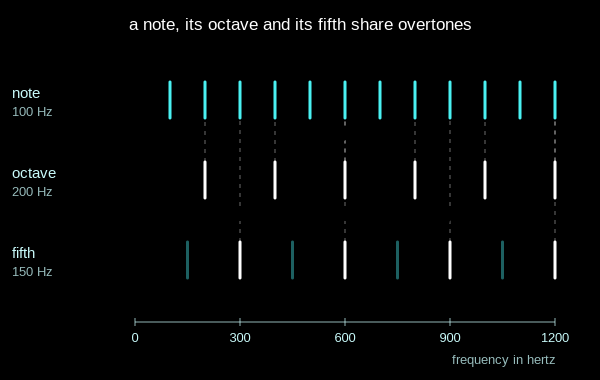
Two tones together repeat every periods of the lower one: octave every period, fifth every 2, fourth every 3, major third every 4, semitone every 15.
The convergents give the best short cycles of fifths. The denominator counts the notes and the numerator the octaves they span: is twelve fifths in seven octaves.
Twelve pure fifths overshoot seven octaves by the Pythagorean comma, 23.46 cents. When twelve tuned fifths , in cents, close on seven octaves, their departures from the pure fifth always add up to this value. Equal temperament takes 1.955 cents from each; meantone takes more from eleven and leaves the wolf.
Two nearly equal frequencies sound as one tone at their average whose loudness throbs times per second. The throbbing vanishes at exact agreement.
From a symmetric repair to octaves, twelve notes and release
- Symmetry decides what a repair can settle into. A rule that treats all 60 rotations of a cell alike can only settle its twelve readings into patterns that the rotations carry into one another: one total, three directions, five and three more. Each fades at its own fixed rate, 0.9539, 0.9 and 0.8794 per pass, and the slowest readable one is space. Group theory calls this Schur's lemma, and it holds for anything that settles under a symmetry. OPH's law is one fixed rule, the same at every step, so the physics built on it treats every moment alike, and an oscillator that comes back to its own state comes back again and again. A sound that repeats every period T is unchanged by a shift of T, and the only patterns such a shift leaves alone are pure tones at one, two, three and more times 1/T. That list is the harmonic series. It plays the part for a repeating sound that the four bands play for the cell.
- Hearing is agreement on a period. The cochlea splits sound into thousands of frequency channels, and the brain has to decide which of them came from one source. Channels whose frequencies share a period are heard as one sound with one pitch. Play 200, 300 and 400 hertz together and you hear 100 hertz, the period all three agree on, although no channel carries it. Telephone voices rely on this, since the line drops the lowest frequencies. Mistune one overtone by a few percent and it splits off as a separate tone. Pitch is a fact the channels hold in common, made by agreement, the way OPH makes physical facts.
- The octave sounds the same and different for an exact reason. A tone at twice the frequency repeats twice in each period of the lower tone, so it also repeats once in each. Every overtone of the upper tone is an overtone of the lower one, and the two together still repeat with the lower tone's period. A detector listening for the lower tone's period finds it in the upper tone too, which carries a shorter period on top. The shared period makes it the same note and the shorter one makes it higher, so pitch is a helix that goes once around the circle of note names per octave while it climbs. The fusion is universal: Tsimane' listeners in the Bolivian Amazon, who grew up with little Western music, take two notes in a simple ratio for a single sound more often than other pairs, as Westerners do. Treating notes an octave apart as one note is learned. Asked to sing tones back, US listeners often land a whole number of octaves away on the same note name, while the Tsimane' keep the intervals and ignore the note name. An observer settles on the agreements its surroundings offer.
- Twelve comes from the arithmetic of 2 and 3. After 2 the next new overtone is 3, and with octaves set aside it gives the fifth, 3 to 2, the next simplest agreement. A stack of fifths never lands exactly on a stack of octaves, because a power of 3 is odd and a power of 2 is even. The best near misses come from the continued fraction of the base-two logarithm of 3/2 and close after 5, 12, 41 and 53 fifths. Twelve is the shortest cycle that comes back within a quarter of a semitone: twelve fifths overshoot seven octaves by 1.36 percent, the Pythagorean comma. In that cycle the fifths miss 3 to 2 by a fiftieth of a semitone and the major thirds miss 5 to 4 by about a seventh of one. Five-note scales and the seven-note major scale are runs of consecutive fifths, and the twelve-note cycle holds them in every key. Cycles of 41 and 53 close better, and 53 appears in Turkish music theory, while scales around the world keep to seven or fewer notes per octave.
- The twelve notes and the twelve ports are different twelves. The ports come from counting the corners of a closed surface, the notes from the arithmetic of 2 and 3, and what the two share is the operation that tunes them. The comma is a loop defect: go once around the circle of fifths and you miss your starting point. However twelve fifths are tuned so that the loop closes on seven octaves, their departures from a pure fifth add up to the same 23.46 cents, so tuning can move the defect and never remove it. Equal temperament spreads it evenly, about two cents per fifth, and every key works. Meantone tuning narrowed eleven fifths further to make the major thirds pure and piled the remainder onto one unusable fifth, the wolf. This is repair in miniature. A disagreement that cannot vanish is spread smoothly or gathered in one place, and gathered in one place it is a knot, the way OPH describes a particle.
- Two tones in a ratio p to q, in lowest terms, sound together as one pattern that repeats every q periods of the lower tone: once for the octave, twice for the fifth, three times for the fourth, four times for the major third and fifteen times for the semitone, 16 to 15. The simpler the ratio, the sooner the channels agree and the more overtones the tones share. Across more than 250 listeners, liking for consonant chords tracks liking for harmonic overtones. Overtones that nearly match throb in loudness, a beat as many times per second as their frequencies differ, and the throbbing stops at exact agreement. Musicians tune by ear until it stops, which is repair by listening. Tension is a disagreement held open and resolution is its repair. Listeners release dopamine in one part of the striatum while anticipating a musical peak and in another at the peak itself. In OPH experience is repair owned by an observer and read from the inside, so a completed repair is a felt release. The Tsimane' dislike rough, beating sounds as Westerners do, yet rate consonant and dissonant chords as equally pleasant. The physics of agreement is the same for everyone, and which agreement feels like coming home is learned.
- Rhythm uses the same small whole numbers in time. A beat is a shared clock, and meter nests beats in twos and threes. Play three beats against two, at three and two beats per second, speed it up a hundredfold, and the clicks fuse into tones of 300 and 200 hertz, a fifth. Rhythm and harmony are one ratio heard at two speeds. OPH has no common clock. Clocks agree by comparing counts when observers meet. A room dancing to one beat is many clocks brought into agreement, and groove is that agreement kept alive by small timing errors that keep being repaired. People who have just sung or moved in synchrony cooperate more in group economic games afterwards.
A brain is an observer that settles disagreement, the same operation that computes the world, and music is that operation made audible. Harmony is agreement on a common period. The octave and the twelve notes follow from the symmetry of repeating sounds and the arithmetic of 2 and 3, and release is a repair felt from the inside. A group making music runs the world's consensus protocol together, on purpose.
See also What is thinking, and how could the universe do it?, What is consciousness?, Why does space have three dimensions?, Why does every piece of reality have exactly twelve ports?, Why do all clocks agree?
Sources: Jacoby and colleagues 2019, octave equivalence in Tsimane' and US singers (Current Biology); McPherson and colleagues 2020, fusion of notes in simple ratios is universal (Nature Communications); McDermott and colleagues 2016, indifference to dissonance in native Amazonians (Nature); McDermott, Lehr and Oxenham 2010, harmonicity underlies consonance (Current Biology); Moore, Glasberg and Peters 1986, hearing mistuned overtones as separate tones (JASA); Salimpoor and colleagues 2011, dopamine during anticipation and peak of music (Nature Neuroscience); Savage and colleagues 2015, statistical universals of human music (PNAS); Wiltermuth and Heath 2009, synchrony and cooperation (Psychological Science)
Also in Chapter 15: Why Does Space Have Three Directions?, Chapter 22: Why Do All the Clocks Agree?.
This answer comes from OPH, Observer Patch Holography. OPH is a rigorous, consistent and complete description of the unified, self-creating computational Universe we inhabit. Its consistency is machine-checked: the fixed point at its core is constructed explicitly, and a theory with a model contains no contradiction.
To understand OPH and check every step yourself, start with the free book Reverse Engineering Reality. It builds the theory from the ground up, and the OPH Notebook answers your questions while you read.
read the free bookask the notebookor ask sage:read chapter 40: Does It Feel Like Anything, and What Is Left to Decide?watch a universe make its own particles